Scissor Cut Versus Clipper Cut for Your Style
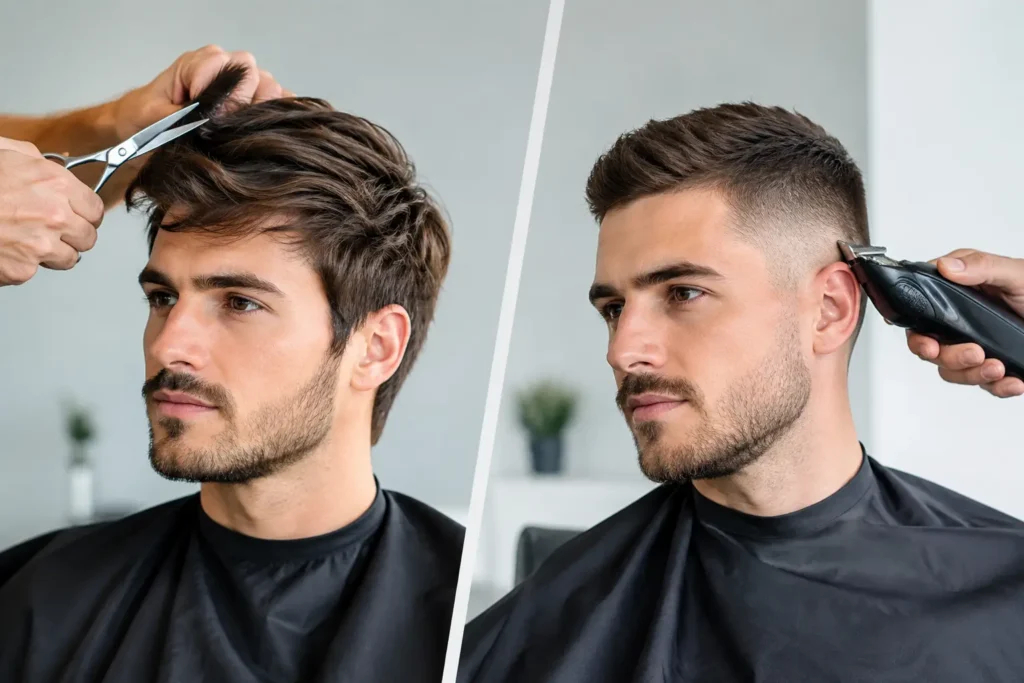
A great haircut is not defined by the tool alone. The real question behind scissor cut versus clipper cut is how you want your hair to move, sit, grow out, and support the rest of your appearance. A close, sharp fade may call for the control of clippers. A textured top with natural volume may need the detail of scissors. Many of the strongest modern cuts use both.
Your barber should not be choosing a technique out of habit. The right approach is built around your hair type, head shape, daily routine, beard style, and the level of polish you want when you walk out the door.
Scissor Cut Versus Clipper Cut: The Main Difference
Scissors and clippers remove hair in fundamentally different ways. Scissors allow a barber to work in smaller sections, control weight, and shape the hair with a more customized result. Clippers use guarded lengths or bare blades to create speed, consistency, and clean transitions, particularly around the sides, back, neckline, and beard.
A scissor cut is often associated with softer movement and a more natural finish. A clipper cut is known for crispness, short lengths, and high-definition contrast. Neither is automatically better. The better choice is the one that fits your style goals and maintenance commitment.
If you wear your hair very short, want a fade that looks tight and deliberate, or prefer the clean structure of a traditional barbershop cut, clippers will likely do much of the work. If you want medium length, texture, volume, or a less uniform shape, scissors become more important.
What a Scissor Cut Does Best
A scissor cut gives your barber more control over shape and texture. Rather than taking every area down to one fixed guard length, the barber can preserve length where your hair needs it, remove bulk where it gets heavy, and create balance around crowns, cowlicks, and uneven density.
This technique is especially effective for men who wear their hair with a side part, loose quiff, brushed-back finish, textured crop, medium-length layers, or relaxed natural movement. It can make thick hair feel lighter without stripping away its body. For finer hair, it can retain enough weight to keep the hair from looking flat or sparse.
Scissor work also tends to create a softer grow-out. Because the lengths are blended gradually and tailored to the direction of your hair growth, the cut may maintain its shape longer than an aggressively short clipper cut. That does not mean it is low maintenance. Longer, textured hair often needs more styling at home, whether that means a blow dryer, a matte paste, a cream, or a pomade with controlled shine.
The trade-off is time and precision. A quality scissor cut cannot be rushed. It requires a barber who understands how your hair behaves dry as well as wet, how much it will spring back, and where to leave weight so the finished style looks right beyond the chair.
What a Clipper Cut Does Best
Clippers create the sharp framework that defines many classic and modern men’s cuts. They are the essential tool for buzz cuts, skin fades, tapers, undercuts, high-and-tight styles, and short crops. They also bring accuracy to sideburns, necklines, and beard transitions.
The biggest advantage is clean consistency. Guard lengths make it possible to establish controlled shortness, while careful fading blends one length into the next. A skilled clipper fade should not show harsh lines, dark patches, or uneven changes in density. It should look smooth from every angle, with a finish that complements the shape of your head and the outline of your beard.
Clipper cuts are ideal when you want a sharp, disciplined appearance with minimal morning effort. A short taper can look polished with little more than a quick brush and a small amount of product on top. A buzz cut may require almost no styling at all.
The maintenance is usually more frequent. A skin fade or very tight taper can start losing its fresh edge within one to two weeks, especially if your hair grows quickly. Men who value that just-cut look often schedule regular cleanups every two to three weeks. Waiting longer is not wrong, but the contrast and precision that made the cut stand out will soften.
The Best Modern Cuts Usually Use Both
Treating scissors and clippers as opposing choices can be misleading. In a well-built haircut, each tool has a role. Clippers may establish a low taper around the ears and nape, while scissors create texture and shape through the top. A barber may use clipper-over-comb to remove bulk around the ridge, then finish with scissors to refine the blend.
This combined approach works for a wide range of looks: a textured crop with a mid fade, a professional side part with a taper, a modern pompadour, or medium-length hair paired with clean, understated sides. It gives you the tailored movement of scissor work without sacrificing the sharp details that keep the overall cut looking intentional.
For clients who wear a beard, the combination becomes even more valuable. Your haircut and beard should look like one considered grooming plan, not two separate services. A tight taper at the sideburn can flow naturally into a beard fade. Scissor work through the top can add height and balance when a fuller beard adds visual weight below the jaw.
Match the Technique to Your Hair and Face Shape
Your hair texture matters as much as the reference photo you bring in. Straight, dense hair can show clipper lines and weight buildup more clearly, so blending is crucial. Wavy hair often benefits from scissor texture that lets its natural pattern work instead of fighting it. Curly or coiled hair can look excellent with clippers, scissors, or both, but the haircut should respect shrinkage, curl pattern, and the desired silhouette.
Face shape also changes the equation. A rounder face may benefit from more height through the top and cleaner, tighter sides. A longer face may look better with less height and more controlled width. If you have a strong jaw and a full beard, a softer scissor-cut top can provide balance. If your style is clean-cut and corporate, a tapered clipper finish with a neatly shaped top can project confidence without looking overdone.
Be honest about your routine. If you do not want to style your hair every morning, say so. If you wear a helmet, work outdoors, hit the gym before the office, or need a cut that stays presentable through a packed week, that information helps your barber recommend a practical shape instead of a style that only looks good for the first hour.
Consider Upkeep Before You Commit
The most impressive haircut is one you can maintain. A short clipper fade demands more frequent barber visits but little daily styling. A scissor-heavy style may stretch longer between appointments, though it can ask more of you in front of the mirror.
Product choice matters, too. Textured scissor cuts often pair well with matte clay, styling cream, or sea salt spray for flexible movement. Sleeker styles may call for pomade or grooming cream. Short clipper cuts usually need less product, but a small amount can still add finish and control to the top.
For beard wearers, do not ignore the maintenance schedule of your facial hair. A haircut that grows out softly may still need a beard lineup to stay crisp. Keeping the cheek line, neckline, and mustache clean can preserve a refined appearance even when you are extending the time between full haircuts.
How to Ask Your Barber for the Right Cut
You do not need barber terminology to get a better result, but clear communication makes a difference. Bring a few photos that show the length, texture, and overall shape you like. Then explain what you like about them. Saying “I want this exact cut” is less useful than saying, “I like the natural texture on top, but I want the sides more conservative.”
Tell your barber how often you are willing to come back, whether you use product, and how your hair behaves on a normal day. Mention any trouble spots, such as a cowlick, thinning area, receding corners, or a beard that grows unevenly. Those details give a skilled barber the information needed to tailor the cut instead of copying a photo blindly.
At Dr. Beard Barbershop, the goal is not simply to choose scissors or clippers. It is to build a haircut and beard profile that looks sharp in the chair, holds up in real life, and fits the way you want to present yourself.
The next time you sit down for a cut, start with the result you want to see in the mirror three weeks later. From there, the right tools become clear: scissors for personalized shape, clippers for clean precision, or both for a finish that carries confidence from every angle.
Visit Dr. Beard Barbershop
Explore our Gentleman’s Cut and plan your next visit.
Visit Dr. Beard Barbershop in Anaheim or our Anaheim Hills location for appointments and shop details.
Get directions: Anaheim | Anaheim Hills.