Signature Haircut Consultation Guide for Men
A strong haircut does not begin with the first clipper pass. It begins when you can clearly explain how you want to look when you walk into the office, head out for the weekend, or check the mirror after a workout. This signature haircut consultation guide helps you get more from that conversation, whether you are maintaining a proven style or ready to sharpen your entire look.
The right consultation is not about knowing barber terminology. It is about giving your barber the details that matter: your lifestyle, your face shape, your beard, your hair behavior, and the amount of time you will actually spend styling each morning. That is how a haircut moves from acceptable to intentional.
Start With the Result You Want
Before discussing a fade, taper, part, or length, think about the finished impression. Do you want a polished professional look that stays clean between meetings? More texture and movement for a relaxed, modern style? A low-maintenance cut that still looks controlled after a busy week?
Those goals give your barber a useful direction. A man who wears a suit most days may need a softer, conservative taper with enough length to style neatly. Someone with a more expressive personal style may prefer stronger contrast, textured layers, or a sharper disconnect. Neither approach is automatically better. The best choice is the one that suits your features and the way you live.
Bring up upcoming events, too. A wedding, job interview, vacation, or professional headshot can affect timing and finish. Some cuts look their sharpest immediately. Others settle in better after several days of natural growth.
Bring Photos, but Explain What You Like
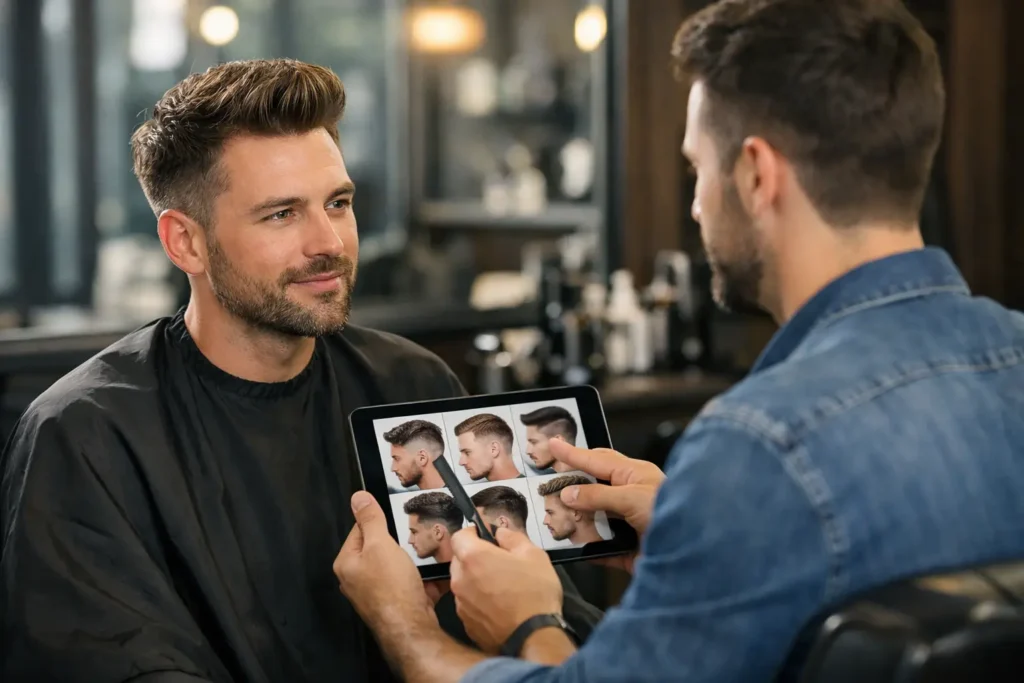
Reference photos can save time and eliminate guesswork, especially if you are making a major change. Use photos with hair similar to yours when possible. A dense, straight-haired style will not behave the same way on fine, wavy, or tightly curled hair, even when the haircut is technically similar.
More importantly, explain what draws you to the image. Maybe it is the clean temple area, the weight left at the crown, the natural texture on top, or the way the beard connects to the sideburn. A skilled barber can translate the idea to your hair type and facial structure rather than copying a photo that does not fit.
It also helps to say what you do not want. If you have had a fade taken too high, a neckline cut too aggressively, or the top left too short to style, say so early. Specific past experiences are valuable consultation information.
Be Honest About Your Daily Routine
The most flattering haircut is not always the most practical one. A textured crop may need product and regular reshaping. A longer top with a clean taper can look excellent, but it may require blow-drying or a few minutes of styling to keep its shape. If your mornings are fast, your barber needs to know that.
Share how much effort you are willing to give your hair. There is a major difference between a client who will use a pre-styler, blow-dryer, and matte clay every day and one who wants to rinse, towel dry, and go. Both can leave with a refined look, but the cut should support the routine.
Also mention hats, helmets, gym sessions, and your work environment. If you wear a cap most of the day, overly precise volume can collapse quickly. If you are often outdoors or on job sites, a style that grows out cleanly may serve you better than one that needs a crisp weekly reset.
Talk About Growth Patterns and Problem Areas
Your barber can see a cowlick, recession pattern, thin crown, or uneven density, but your experience with it matters just as much. Tell them where your hair sticks up, falls flat, separates, or gets difficult once it reaches a certain length.
A cowlick at the front can influence which direction the hair should be styled. A thinning crown may benefit from strategic texture and balanced length rather than excessive length that exposes more scalp. Receding corners can often look stronger with a shape that works with the hairline instead of fighting it.
This is where craftsmanship matters. A good cut does not pretend your natural hair patterns are not there. It uses weight, texture, and shape to make them work in your favor.
Your Beard Should Be Part of the Consultation
For men with facial hair, the haircut and beard should never be treated as two separate decisions. The sideburn transition, cheek line, jaw definition, and neckline all influence the overall balance of your face.
A short fade paired with a full beard creates high contrast and can make the jaw look stronger. A more gradual taper may be better if you want a smoother, more classic transition. If your beard has uneven density, a precise lineup and controlled length can create a fuller, cleaner appearance without making the shape look artificial.
Tell your barber whether you are growing your beard out, maintaining a specific length, or considering color coverage for gray. The right haircut can make a growing beard look purposeful instead of unfinished. At Dr. Beard Barbershop, that full-picture approach is central to creating a grooming plan that feels consistent from hairline to neckline.
Ask the Questions That Prevent Regret
You do not need a long list of technical questions. A few direct ones will give you clarity before the service begins. Ask how the cut will grow out, how often it should be maintained, and what it will take to style at home. If you are considering a dramatic change, ask whether there is a more gradual version worth trying first.
This is especially useful when going shorter. You can always remove more length, but you cannot add it back during the appointment. If you are unsure about a high fade, a skin finish, or taking several inches off the top, start with a measured change. Your barber can refine it after you see the shape taking form.
You should also ask for product guidance that matches your finish. A natural, flexible look may call for a lightweight cream or sea salt spray. Defined texture and stronger hold may need a clay, paste, or fiber. The product matters, but the amount matters just as much. Too much can flatten fine hair or make a clean haircut look heavy.
Use Clear Language During the Service
A consultation is not a one-minute exchange at the chair. Stay engaged as the haircut takes shape. If the barber asks about length or transition, answer with the result you want rather than guessing at clipper numbers. Saying, “I want to see some scalp but not have it taken to the skin,” is more useful than choosing a number you are not confident about.
If something feels different from what you pictured, speak up before the finishing stage. A professional barber would rather adjust the direction while there is time than have you leave quietly disappointed. Precision depends on communication from both sides.
At the end, ask to see the profile, back, and beard lines from more than one angle. The mirror check is your opportunity to confirm that the haircut feels balanced from every view, not only straight on.
Build a Maintenance Plan That Fits Your Schedule
Signature grooming is built through consistency. A skin fade or sharply defined beard lineup may need attention every one to two weeks to stay at peak crispness. A classic taper, medium-length scissor cut, or natural beard shape can often go longer, depending on how quickly your hair grows and how structured you want the finish to look.
There is a trade-off between a lower-maintenance style and a highly detailed one. The sharper the lines and tighter the blend, the sooner growth becomes visible. That does not mean every man needs frequent appointments. It means your consultation should end with a realistic schedule, not a haircut that looks great for three days and frustrating for the next three weeks.
Your barber should also show you how to recreate the finish at home. Watch the direction of the blow-dry, where product is applied, and how the hair is shaped with the hands. A few small techniques can protect the investment you made in the chair.
The best haircut consultation leaves you with more than a clean cut. It gives you a clear plan for how to wear it, maintain it, and carry yourself with confidence until your next visit.
Visit Dr. Beard Barbershop
Explore our Gentleman’s Cut and plan your next visit.
Visit Dr. Beard Barbershop in Anaheim or our Anaheim Hills location for appointments and shop details.
Get directions: Anaheim | Anaheim Hills.