Barbershop Fade vs Salon Haircut – Which Fits?
A sharp fade can make a tailored shirt look cleaner, your jawline look stronger, and your entire routine feel more intentional. But when choosing a barbershop fade vs salon haircut, the real question is not which service is better. It is which professional is built for the result you want when you leave the chair – and how that result needs to work with your hair, beard, and lifestyle.
For many men, the decision comes down to precision versus length, maintenance versus versatility, and whether beard work belongs in the same appointment. Both barbers and salon stylists can be highly skilled. Their training, tools, consultation style, and day-to-day specialties simply tend to point in different directions.
Barbershop Fade vs Salon Haircut: The Core Difference
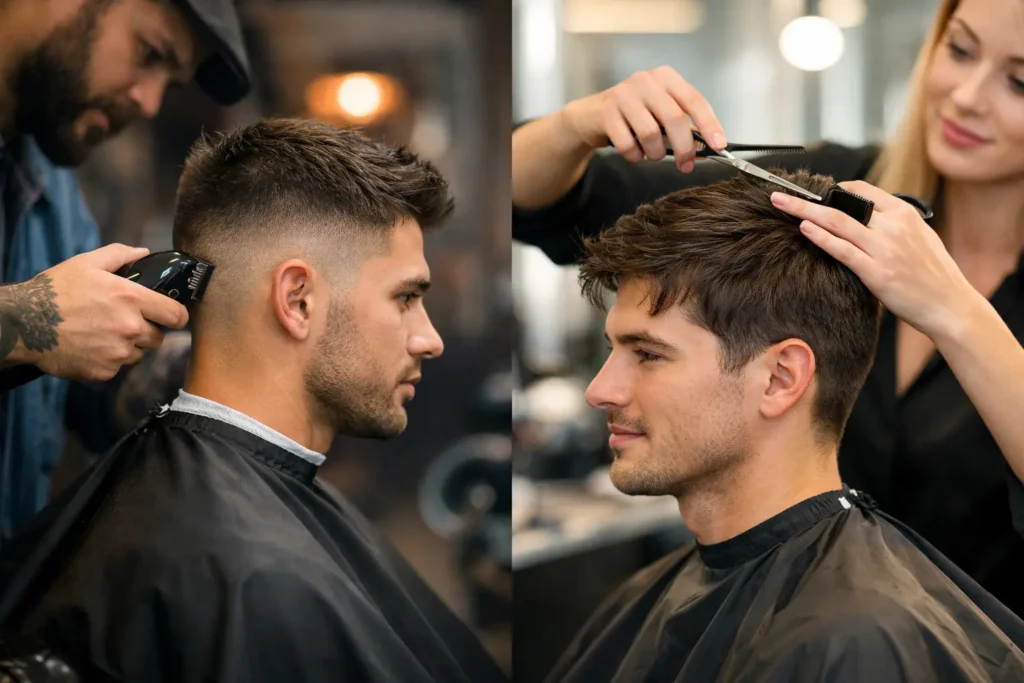
A barbershop is traditionally centered on short men’s cuts, clipper work, shaving, and facial hair maintenance. A fade is one of the clearest examples of that craft. It requires controlled transitions from skin or near-skin length into progressively longer hair, with no harsh lines, dark patches, or uneven weight around the head.
A salon haircut often places more emphasis on scissor technique, layering, length management, texture, and styling versatility. That can make a salon an excellent choice for men growing their hair out, wearing medium to long hair, or looking for a more editorial, movement-driven shape.
The distinction is not absolute. Plenty of barbers handle longer styles well, and many salon stylists create clean fades. What matters is the professional’s demonstrated specialty. If your desired look depends on a flawless taper at the temples, a crisp neckline, and a beard that connects naturally to the haircut, a barber who performs those services every day has a clear advantage. If you want shoulder-length layers, major length preservation, or a style designed around extensive blow-drying, a salon specialist may be the better match.
Why a Fade Demands Barber-Level Precision
A fade looks simple only when it is done right. The clean finish comes from a sequence of clipper guards, lever control, blending strokes, detail work, and careful assessment of the head shape. A skilled barber does not create the same fade on every client. He adjusts the placement and transition based on hair density, cowlicks, recession, crown shape, and the level of contrast you want.
A low fade keeps the blend close to the ear and neckline, leaving more weight around the sides. It is a strong option for a conservative office environment or for men who want a subtle cleanup without showing too much scalp. A mid fade creates more definition near the temples and works well with textured crops, pompadours, and balanced short styles. A high fade offers the most contrast and can make a strong style statement, though it grows out faster and may not flatter every head shape.
The final details matter just as much as the blend. Barbers are trained to refine the hairline around the forehead, ears, and nape with trimmers and, when appropriate, a straight razor. That close finishing work gives a fade its polished edge. It also calls for restraint. An overly pushed-back lineup can look sharp for a few days but create an awkward grow-out and gradually weaken the natural hairline.
When a Salon Haircut Is the Smarter Choice
A salon haircut can be the right call when your goal is less about clipper precision and more about shape, length, and movement. Men with medium to long hair often benefit from detailed scissor work that removes bulk without sacrificing the ability to tie hair back, sweep it to the side, or wear it naturally textured.
It can also be a better fit if you are making a major change in length or want help styling hair that behaves differently once it gets past the ears. Layering, fringe design, and longer curtain styles require an understanding of how hair falls, dries, and moves over time. A strong stylist can create a shape that looks intentional instead of simply overgrown.
That said, do not assume a salon service automatically means more refined work. Ask whether the stylist regularly cuts men’s hair in your preferred length and style. Look for consistent examples of the finish you want. The same principle applies at a barbershop: choose the specialist whose work reflects your goal, not just the business category on the sign.
Hair Type Changes the Answer
Your hair texture should influence the decision. Straight, dense hair can reveal every inconsistency in a fade, so careful blending is essential. Coarse or curly hair can create beautiful dimension in a taper or drop fade, but it needs a barber who understands how the curl pattern compresses and expands. Fine hair often benefits from smart weight removal and a fade placement that does not expose more scalp than intended.
A consultation should go beyond asking, “What number on the sides?” Your barber or stylist should ask how you wear your hair, how often you are willing to maintain it, whether you use product, and what you disliked about your last cut. A few honest answers can prevent a style that looks great under shop lighting but does not suit your normal morning routine.
Face shape matters, too. A high fade with height on top can lengthen a rounder face. A lower taper with controlled volume can keep a long face from appearing even longer. The best cut does not follow a trend blindly. It uses proportion to make your features work harder for you.
The Beard Is Often the Deciding Factor
If you wear a beard, the barbershop advantage becomes more obvious. Your haircut and facial hair should look like one considered design, not two separate services completed weeks apart. The sideburn transition, cheek line, neckline, mustache shape, and beard density all affect how the finished haircut reads.
A barber can blend the sideburns into a fade, soften the connection into a short beard, or create contrast between a tight haircut and a fuller, sculpted beard. For a professional appearance, this kind of coordination can make the difference between looking merely groomed and looking fully put together.
Beard maintenance also requires tools and techniques that many salons do not prioritize: precision trimmers, hot lather, straight-razor detailing, beard color blending, and tailored lineups. At Dr. Beard Barbershop, the haircut can be paired with beard artistry and traditional shaving services, making it easier to maintain a consistent, refined look in one appointment.
Maintenance, Timing, and Value
The right choice has to fit your calendar. A skin fade is high-impact but high-maintenance. Most men who want it looking consistently fresh schedule a cleanup every one to three weeks, depending on hair growth and how sharp they prefer the blend. A low taper or longer scissor cut may hold its shape for four to eight weeks.
Do not judge value by the appointment price alone. Consider how well the haircut grows out, whether the professional understands your preferences without repeated corrections, and whether you can handle your hair at home. A slightly more detailed service that stays balanced and saves you from a corrective cut is usually the better value.
Communication is part of the service. Bring a reference photo if you have one, but explain what you like about it: the low transition, the textured top, the natural hairline, or the beard connection. Photos are useful, yet your density, curl pattern, and face shape may call for an adapted version rather than an exact copy.
How to Choose With Confidence
Choose a barbershop when you want a fade, taper, buzz cut, lineup, shave, or beard service executed with clean, repeatable precision. It is also the practical choice when your personal style depends on a tight schedule and a consistently polished finish.
Choose a salon when length, layered shape, and styling flexibility are the priority. If you are growing your hair, wearing a longer flow, or looking for a dramatic reshape without losing more length than necessary, seek a stylist whose portfolio shows confidence with men’s longer hair.
There is no rule against using both at different stages. Some men visit a barber for regular fades and beard maintenance, then see a long-hair specialist when they decide to grow out a new style. What matters is that the professional understands the destination, not just the next haircut.
Your best cut should still look intentional two weeks later, fit the way you dress, and make the mirror feel like a confidence check rather than a compromise. Book the service that supports that standard, then give your grooming the same consistency you expect from the rest of your presentation.
Visit Dr. Beard Barbershop
Explore our Signature Cut and plan your next visit.
Visit Dr. Beard Barbershop in Anaheim or our Anaheim Hills location for appointments and shop details.
Get directions: Anaheim | Anaheim Hills.