Straight Razor Shave Guide for a Cleaner Finish
A bad shave usually gives itself away by noon. Razor burn starts to sting, your neck looks blotchy, and the spots you missed catch the light. A proper straight razor shave guide is not about making shaving feel complicated. It is about getting closer results, cleaner lines, and a finish that looks intentional instead of rushed.
For men who care about presentation, the straight razor still stands apart. It delivers a level of precision that cartridge razors struggle to match, especially around the cheeks, neck, and beard line. But the tool only performs well when the prep, angle, and pressure are right. That is where most shaves are won or lost.
Why a straight razor shave still earns its place
There is a reason the straight razor remains part of classic barbering. It is not nostalgia alone. The blade gives you direct control over every pass, which matters when you want a sharp neckline, a smooth cheek, or a detailed beard edge that complements your haircut and face shape.
It also forces better technique. Cartridge razors let men get careless because the guard does some of the work. A straight razor does not. The reward is a closer, more refined result, but only if you respect the process. If your skin is sensitive or your beard grows in multiple directions, that control can actually help reduce irritation once your technique improves.
That said, it is not always the fastest option. If you are rushing before work, a straight razor may feel like more tool than you need. For many men, it becomes less of an everyday move and more of a weekly reset or a finishing tool for key areas.
Straight razor shave guide: start with the right prep
The shave begins before the blade touches your skin. Prep is what softens the beard, relaxes the skin, and lowers the odds of drag. Skip it, and even a sharp razor will feel harsh.
Start by washing your face with warm water. The goal is not just cleanliness. You want heat and moisture to soften the hair shaft so the blade can cut through it cleanly. Shaving dry or on barely damp skin is one of the fastest ways to create tugging and irritation.
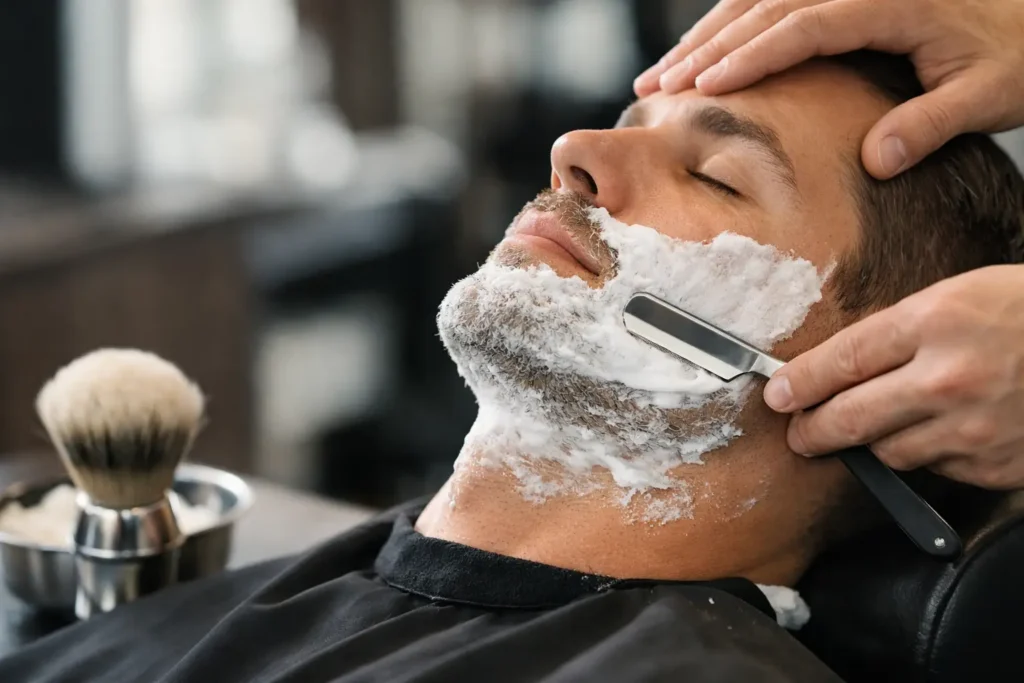
If you have the time, hold a warm towel to your face for a minute or two. This old-school step still works because it opens the beard up and makes dense growth easier to manage. Then apply a quality shaving cream or lather with enough cushion to keep the blade gliding. You do not need foam piled an inch high, but you do need coverage that stays slick through the pass.
Men with coarse beards should take this stage seriously. Thick growth around the chin and upper lip can punish rushed technique. Better prep means less force later, and less force is what keeps the shave clean.
Know your grain before you shave
One of the most common mistakes is shaving based on habit instead of beard growth. Beard hair rarely grows in one neat direction. The cheeks may go down, the neck may grow sideways, and the jawline may shift in a diagonal pattern.
Take a minute to map it out with your hand when your beard is at least a day or two long. When you know the grain, each pass becomes more deliberate. That matters because going against the grain too early is where a lot of razor bumps begin.
Technique matters more than courage
A straight razor can look intimidating, but the real skill is not aggression. It is restraint. The blade should work at a shallow angle, usually around 30 degrees or less against the skin. Too flat, and it may not cut effectively. Too steep, and it starts scraping.
Use your free hand to keep the skin taut. This creates a smoother surface and helps the blade move evenly without catching on loose skin. Short, controlled strokes are better than long sweeping motions, especially while you are learning. Around curved areas like the jaw and chin, smaller strokes give you more control and reduce the risk of nicks.
Pressure should stay light. Think of guiding the blade, not pressing it in. If you feel like you need force, the problem is usually one of three things: the beard was not prepped enough, the lather has dried out, or the blade is not sharp enough.
Build the shave in passes
The cleanest result usually comes from multiple light passes instead of one aggressive one. Start with the grain. That first pass is about reducing bulk, not chasing perfect smoothness.
Reapply lather before the second pass. If your skin handles shaving well, go across the grain for more closeness. Some men can go against the grain in certain areas, but that depends on skin sensitivity, hair texture, and technique. The neck is usually the area where men get too ambitious. If your neck tends to react badly, stop at across the grain and accept a clean, comfortable finish over a glass-smooth one that turns into razor burn an hour later.
This is where a professional straight-razor service has a real advantage. A skilled barber knows how to read the grain, adjust the angle, and decide how far to push for closeness without crossing into irritation.
Areas that need extra attention
The upper lip, chin, and neck usually separate a decent shave from a sharp one. These zones have thicker growth, more contour, or both.
The upper lip benefits from extra prep and very short strokes. Trying to rush this area often leads to skipping or overworking the same spot. The chin is tougher because the surface curves and the hair is dense. Stretch the skin where possible, shift the angle as needed, and reduce expectations for a one-pass result.
The neck is where discipline matters most. Many men want an ultra-close neck shave, but it is also the area most prone to ingrown hairs. If your neck is sensitive, favor a cleaner line and a comfortable result over maximum closeness. A polished appearance does not require irritation.
Blade condition changes everything
Even excellent technique cannot rescue a poor blade. A dull edge causes pulling, repeated passes, and unnecessary trauma to the skin. A properly honed blade should feel smooth and efficient, not rough.
If you use a traditional straight razor, maintenance matters. Stropping before each shave helps align the edge. Periodic honing restores it. If that sounds like more upkeep than you want, a shavette offers similar precision with disposable blades, though many men find it less forgiving because the blade feel is more direct.
There is a trade-off here. A classic straight razor offers a more refined shaving experience when maintained well. A shavette is simpler from a sanitation and maintenance standpoint, but technique has to be even more disciplined.
Aftercare is part of the shave
A strong finish does not stop when the last pass is done. Rinse with cool water to calm the skin and remove residual lather. Then pat dry. Do not rub your face with a towel like you are sanding wood.
Apply an alcohol-free aftershave balm or soothing moisturizer. The right product helps reduce tightness and supports the skin barrier after exfoliation from the blade. If you are shaving around a beard or mustache, a little beard oil on the surrounding hair can keep everything looking conditioned and intentional.
Give your skin time before applying anything heavily fragranced. Freshly shaved skin is more reactive, and men often mistake product sting for proof that something is working. Comfort is the better standard.
Common mistakes that ruin the result
Most straight razor problems are technique issues, not razor issues. Rushing the prep, using too much pressure, and shaving the same spot repeatedly are the biggest offenders. So is trying to get perfectly smooth skin in one pass.
Another mistake is treating every part of the face the same. Your cheeks may tolerate a close pass against the grain, while your neck absolutely will not. A better shave comes from adapting the method to the area, not forcing one approach across the whole face.
And if your beard work includes shaping a lineup, remember that symmetry is easier to maintain when you remove less at a time. Once a cheek line or neckline is cut too high, there is no technique fix for that. Only patience.
When to do it yourself and when to book the service
A straight razor shave at home can be worth learning if you enjoy the ritual and want control over your grooming. It suits men who pay attention to detail and do not mind slowing down for better results. But if your goal is a flawless finish before an event, a photo-ready beard cleanup, or a luxury reset that leaves you looking sharp without trial and error, a professional service makes sense.
That is especially true if your beard density, skin sensitivity, or growth pattern makes shaving unpredictable. In a barbershop setting, the hot lather, skin prep, and expert blade work elevate the result. At Dr. Beard, that craftsmanship is part of the experience, not an extra.
A straight razor rewards patience, precision, and respect for the details. Get those right, and the shave does more than remove hair. It sharpens the way you carry yourself.
Visit Dr. Beard Barbershop
Explore our beard shave and plan your next visit.
Visit Dr. Beard Barbershop in Anaheim or our Anaheim Hills location for appointments and shop details.
Get directions: Anaheim | Anaheim Hills.